

What I Would Do Differently in My Pull-Up Journey After 60
Lo que cambiaría si volviera a empezar con las dominadas después de los 60

Español abajo
I started training for pull-ups at 60, fresh out of recovering from a partially torn rotator cuff.
It took me nine months to get my first pull-up, and it was not great. I still celebrated like crazy because getting my chin over the bar at 60, after a shoulder injury, was a big deal.
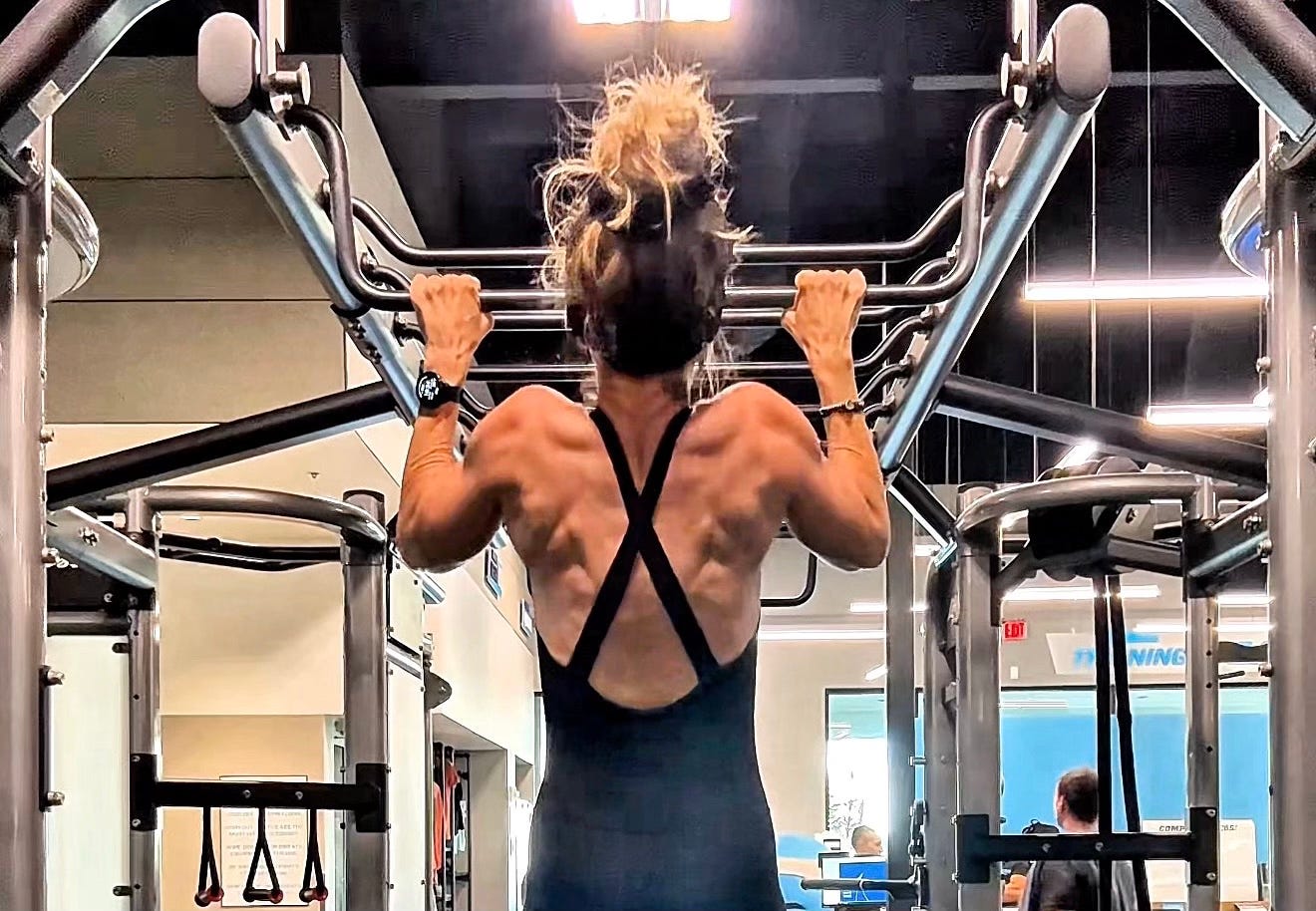
Then I had to clean it up. I wanted to extend my arms fully at the bottom. That took longer.
The biggest missing piece was the brain-lat connection. I knew my lats were supposed to do a lot of the work. That didn’t mean I could actually feel them doing it. The older we are, the harder it is!
Once I finally got that connection, relatively recently, at 62, my pull-ups changed fast. My arms and shoulders stopped doing all the pulling, and my back finally got the memo.
Now I’m up to five overhand pull-ups on a good day, which was my goal for the end of the year. I’m more concerned with form and safety at this point, but if I increase my reps, I will not be sad.
What I Would Do Differently
I would buy and actually use the Duonamic Eleviia grips sooner. I bought them for travel, but now I use them daily at home. They are much kinder on my older body than a fixed bar, and they helped me feel that mind-lat connection in a way the bar never quite did, although I still do my main pull-up work at the gym with a fixed bar.
I would keep the grips up all the time, the way I do now, so I could practice daily without making it a whole thing.
I would do at least one pull-up attempt a few times a day, even if it were a negative or with resistance. Once I started doing this, my lats woke up. I wasn’t doing a workout every time. I was just touching the skill often enough that my body started to understand it.
I would ditch the gloves and use liquid chalk sooner. This was a wild game-changer. My grip got stronger. I can feel the bar better. Yes, I have calluses now. I’ll take them over not getting the skill.
I would do more hollow plank holds earlier on. Thank you, Angela Gargano, for that tip. Pull-ups are not just an arm and back skill. The hollow position matters. That said, my rotator cuff wasn’t loving planks early on, so I had to be careful and work with what my shoulder could handle.
I would play around sooner with what helped me fire up my lats before pull-ups. For me, it was banded straight-arm pulldowns. Once I found that connection, everything changed. My pull-ups stopped feeling like I was muscling my way up with my arms and shoulders, and started feeling like my back was finally doing its job.
What I Would Not Change
What I would not change is the sheer determination.
I kept going when it was ugly, slow, frustrating, and humbling. I kept going when one imperfect rep was the whole victory. I’m glad I didn’t quit.
If You’re Working on Something That Feels Impossible
If you’re a woman over 50 or 60 working on pull-ups, especially if you’re coming back from injury, I don’t think the answer is to grind harder.
Sometimes the missing piece is a better setup, a better cue, more frequent practice, or finally finding the connection that lets the right muscles do the work.
For me, that was the brain-lat connection. Once that clicked, everything changed.
And maybe this applies to more than pull-ups. Sometimes we don’t need to quit, and we don’t need to keep forcing the same approach either. Sometimes we need to change the setup, find the missing piece, and keep going.
What’s something you’re still working on, even if it’s taking longer than you expected?
Español
Empecé a entrenar dominadas a los 60, recién recuperada de una rotura parcial del manguito rotador.
Tardé nueve meses en conseguir mi primera dominada, y no fue gran cosa. Aun así, lo celebré como loca, porque conseguir pasar la barbilla por encima de la barra a los 60, después de una lesión de hombro, era un logro enorme.
Luego tuve que pulirla. Quería extender los brazos del todo. Eso me llevó más tiempo.
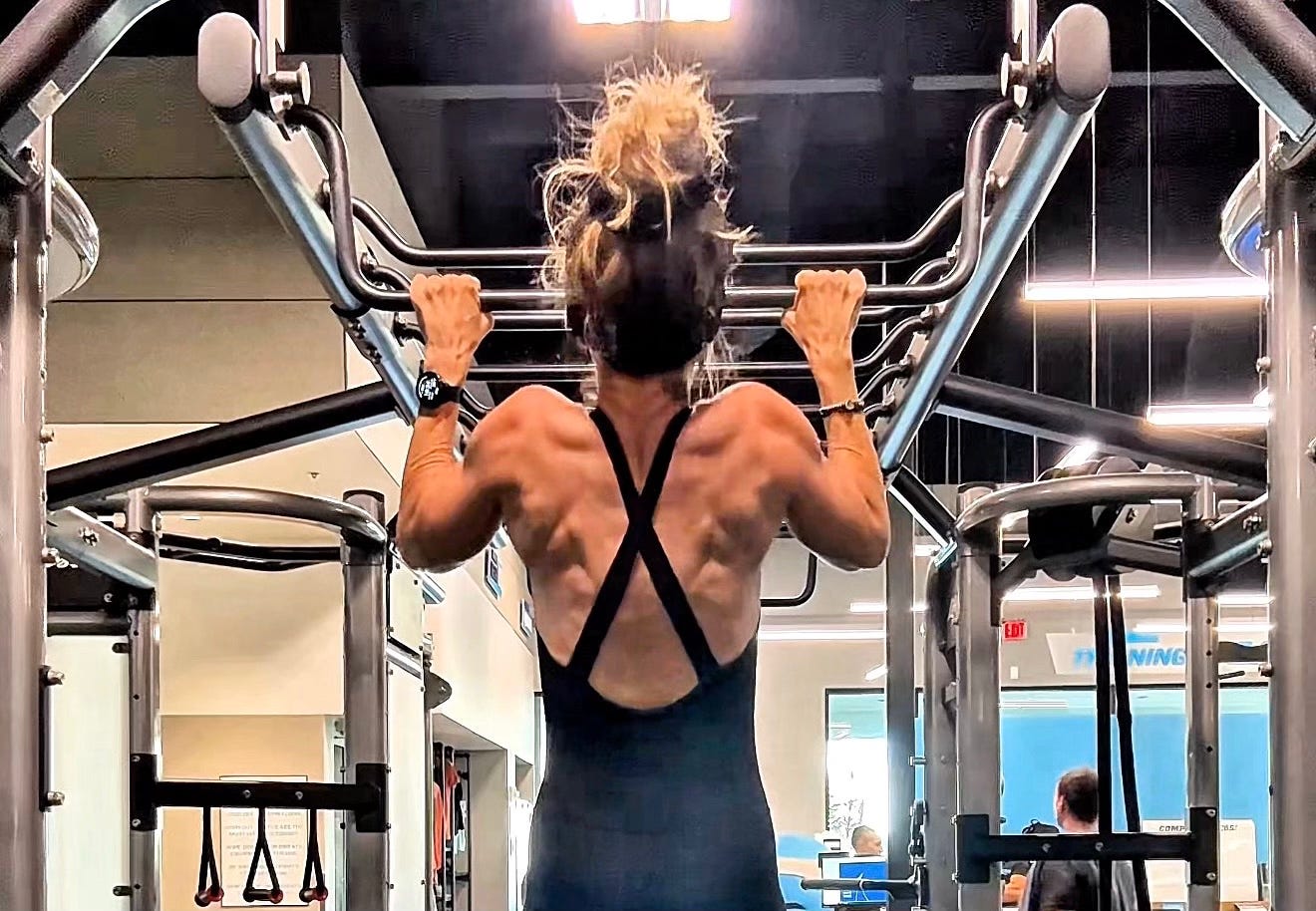
La pieza que más me faltaba era la conexión cerebro-dorsal. Yo sabía que los dorsales tenían que hacer gran parte del trabajo. Pero eso no significaba que pudiera sentirlos haciéndolo. A más edad, más difícil es.
Cuando por fin conseguí esa conexión, hace relativamente poco, ya con 62, mis dominadas cambiaron rápido. Mis brazos y hombros dejaron de hacer todo el trabajo, y mi espalda por fin se enteró de lo que tenía que hacer.
Ahora he llegado a cinco dominadas con agarre prono en un buen día, que era mi objetivo para finales de año. En este momento me importa más la técnica y la seguridad, pero si aumento las repeticiones, tampoco me voy a quejar.
Lo que cambiaría
Compraría y usaría antes los agarres Duonamic Eleviia. Los compré para viajar, pero ahora los uso a diario en casa. Son mucho más amables con mi cuerpo de más edad que una barra fija, y me ayudaron a sentir esa conexión mente-dorsal de una manera que la barra nunca llegó a darme del todo, aunque sigo haciendo mi trabajo principal de dominadas en el gimnasio con barra fija.
Dejaría los agarres puestos en el quicio de la puerta todo el tiempo, como hago ahora, para poder practicar a diario sin convertirlo en todo un acontecimiento.
Haría al menos un intento de dominada varias veces al día, aunque fuera una negativa o con asistencia. Cuando empecé a hacer esto, mis dorsales despertaron. No estaba haciendo un entrenamiento cada vez. Simplemente estaba tocando la habilidad con suficiente frecuencia para que mi cuerpo empezara a entenderla.
Dejaría los guantes y usaría magnesio líquido antes. Esto fue un cambio brutal. Mi agarre se hizo más fuerte. Siento mejor la barra. Sí, ahora tengo callos. Los prefiero antes que no conseguir la habilidad.
Haría más planchas antes. Gracias, Angela Gargano, por ese consejo. Las dominadas no son solo una habilidad de brazos y espalda. La posición importa. Dicho esto, al principio a mi manguito rotador no le hacían ninguna gracia las planchas, así que tuve que ir con cuidado y trabajar con lo que mi hombro podía tolerar.
Probaría antes qué me ayudaba a activar los dorsales antes de las dominadas. Para mí, fue tirar hacia abajo con los brazos rectos usando una banda. Cuando encontré esa conexión, todo cambió. Mis dominadas dejaron de de ser algo que hacía tirando de brazos y hombros, y mi espalda empezó a hacer la mayoría del esfuerzo.
Lo que no cambiaría
Lo que no cambiaría es la pura determinación.
Seguí a pesar de todos los momentos difíciles e incluso lesiones. Seguí cuando una sola repetición imperfecta era mi única victoria. Me alegro de no haberlo dejado.
Si estás trabajando en algo que parece imposible
Si eres una mujer de más de 50 o 60 años trabajando en las dominadas, sobre todo si estás volviendo después de una lesión, la respuesta no es entrenar más, sino mejor.
A veces la pieza que falta es una mejor configuración, una mejor señal, practicar con más frecuencia, o por fin encontrar la conexión que permite que los músculos correctos hagan el trabajo.
Para mí, fue la conexión cerebro-dorsal. Cuando eso hizo clic, todo cambió.
Y quizá esto se aplica a algo más que las dominadas. A veces no tenemos que rendirnos, pero tampoco tenemos que seguir forzando el mismo enfoque. A veces hay que cambiar la configuración, encontrar la pieza que falta y seguir.
¿Qué es algo en lo que sigues trabajando, aunque te esté llevando más tiempo del que esperabas?
I’m so excited to be back training for pull-ups!